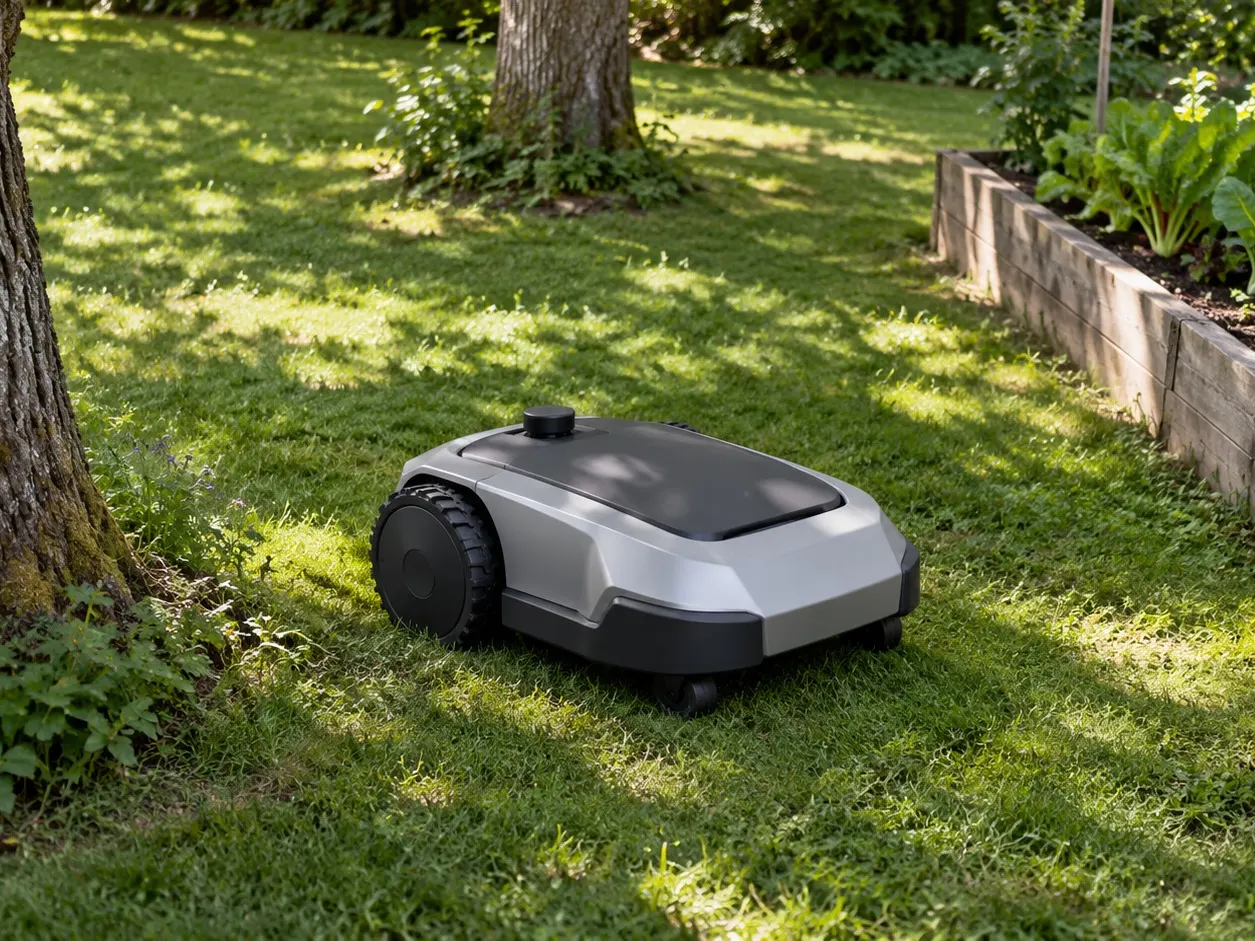
Trees are a common reason for a wire-free mower to lose its way. Most of these mowers find their place on the lawn with satellites, and a dense canopy, a roof or a tall wall blocks the signal. Whether that matters depends on how the mower positions itself. Some don't use satellites at all (34 of the 87 we track), and many of the others carry a camera or a laser scanner to keep going where the signal fades.
How RTK works, and why trees get in the way
Plain GPS can be off by a few meters, which is far too loose for mowing up to a flower bed. RTK fixes that with a second receiver, an antenna at a fixed spot in your yard. Because the antenna knows exactly where it stands, it can work out the error in the satellite signal and send a correction to the mower. TechRadar puts the result at a few centimeters.
Both ends need a clear view of the sky. Husqvarna says tall buildings or dense trees with crowns over 4 m (13 ft) across can block the signal in the area under them. Navimow lists high walls, dense trees and buildings as the usual causes when its mowers report a weak position. Problems usually start with a row of mature trees, not a single small one.
How each type copes with cover
| Positioning | How it works | Under trees | Fit check, dense trees | Models |
|---|---|---|---|---|
| RTK satellite | Satellites plus correction data from an antenna, or a network service | Loses its position under dense trees or a roof | Doesn't fit under dense trees; tight fit with some trees or tall walls | 14 |
| RTK + camera | Satellites, with a camera to keep going where the signal drops | Copes with patches of cover for a limited distance | Tight fit under dense trees or near tall walls | 32 |
| RTK + LiDAR + camera | Satellites, LiDAR and a camera together | LiDAR and camera take over where satellites drop out | Tight fit under dense trees or near tall walls | 7 |
| LiDAR | A laser scanner builds a map of the yard | Doesn't need the sky at all | Fits | 28 |
| Camera only | Cameras only, following the grass | Doesn't need the sky; needs daylight | Fits | 6 |
Number of models on sale in at least one of the US, Canada, the UK and Australia.
Satellite mowers with a camera are the biggest group. The camera doesn't replace the satellites. Husqvarna describes its vision models as able to continue "for a limited distance, provided it can see grass", which is fine for a patch of shade and not for a lawn that sits under trees from end to end. Mammotion says LiDAR and vision take over on the LUBA 3 where buildings or trees block the sky, and Sunseeker makes a similar claim for the X7 Gen 2.
LiDAR mowers scan the yard with a laser and recognize where they are from the shapes around them, so tree cover doesn't bother them. Mova says its LiDAX range works day or night and without GPS. Camera-only mowers such as the Eufy E15 and the Worx Landroid Vision follow the grass itself. Worx says the Vision stays within solid sections of grass but can cross driveways, walkways and stepping stones to reach another area.
Where to put the antenna
If you go for a satellite mower, where you put the antenna matters, and the makers broadly agree on it. Husqvarna wants its reference station at least 2 m (6.6 ft) off the ground with a clear view of the sky. Navimow asks for the same 2 m of distance from walls, dense trees, houses and fences, plus an open view of more than 110° of sky. Mammotion's rule of thumb near a tree with dense leaves is easy to remember: keep the station as far from the tree as the tree is tall, and at least 5 m (16 ft) away from large glass walls or metal.
On most houses that points to somewhere high on a wall or a post near the shed. The antenna usually needs an outlet, so check how long the power cable is before you drill any holes.
No antenna: network RTK
Some brands can get the corrections over the internet instead, from a network of reference stations. Husqvarna offers this for its EPOS models through Husqvarna Cloud, with coverage in the UK and Ireland, limited coverage in parts of the US and partial coverage in Australia. Mammotion calls its service iNavi and says it's free for the life of compatible models. Navimow includes network RTK at no extra cost where coverage exists, and says coverage is still patchy in North America while it covers its sales regions in Australia and New Zealand. 43 of the models we track can use a network service.
Network RTK saves you the antenna, but the mower still needs to see the satellites, so it doesn't help under trees. It also needs a data connection, through your Wi-Fi or a 4G module, which may become a paid plan after the free period.
Choosing for a lawn with trees
Tell the fit check what's above your lawn. With "Some trees", satellite-only models drop to a tight fit. With "Lots of trees", or part of the lawn under a carport or pergola, they drop out and satellite models with a camera become a tight fit. LiDAR and camera models stay in. If tall walls or buildings line more than half the edge, tick that as well, because walls block part of the sky and can bounce the signal.
Shade also changes the grass. It grows more slowly and thinly under trees, and roots near the surface can stop a mower that only clears low obstacles. Each model page lists the obstacle height where the maker publishes it.
Common questions
Does a wire-free robot mower need an RTK antenna?
Only the satellite (RTK) models do, and some of those can use a network correction service instead where it covers your address. Camera and LiDAR models need no antenna at all. Of the 87 wire-free models on sale in our four countries, 34 work without one.
Can a robot mower work under trees?
Yes, if it doesn't depend on satellites alone. A LiDAR or camera mower works under a full canopy. A satellite mower with a camera can bridge patches of cover. A satellite-only mower loses its position under dense trees and stops or wanders off its planned lines.
Do camera-only robot mowers work at night?
It depends on the brand. Eufy tells owners not to run its mowers after sunset. Worx says the Landroid Vision can mow at night and sells a separate headlight for it. LiDAR and satellite models don't need light to find their way, though in the UK hedgehog charities ask you to mow in daylight anyway.
More guides
-
 Robot mowers for slopes and hills: what the ratings meanWhat a slope rating covers, why the edge of a slope is harder than the middle, and which mowers are rated for steep lawns.
-
 Robot mower for 1 acre: how big a rating you needWhy a mower rated for exactly 1 acre struggles on 1 acre, and how much headroom to look for.
-
 Robot mowers for narrow gaps and side passagesMakers ask for anything from 55 cm to 2 m. The minimum gap per model, and how to measure yours.
-
 Robot mowers for two or more separate lawnsFront and back lawns, paths, driveways and how many separate areas each brand supports.
-
 Do robot mowers get stolen? Anti-theft features comparedPIN codes, alarms, account locks and GPS tracking, and which of them need a data plan.
-
 How much does a robot mower cost?Shop prices per country from our latest price check, plus blades, data plans and batteries.